
greenconnect by Stannol
Soldering products with defined social and environmental criteria
Under the greenconnect name, Stannol offers a product range subject to defined requirements for raw material sourcing, material selection and product design.
For many years, tin purchasing decisions were primarily based on quality, price and availability. However, tin extraction can pose risks to people and the environment. These include poor working and living conditions in mining regions and adverse impacts on ecosystems, particularly as a result of uncontrolled or illegal mining.
With greenconnect, Stannol helps customers take social and environmental factors into greater consideration when selecting soldering materials. The applicable criteria and available supporting documentation are provided on a product- or batch-specific basis.
The five areas of greenconnect
- Solder bars containing tin from Fairtin sources
- Solder wires containing tin from Fairtin sources
- Solder pastes containing metal powder made with tin from Fairtin sources
- Fluxes based on renewable raw materials and/or water-based formulations
- Packaging materials with recycled content, including solder wire spools made from recycled material as well as packaging and filling materials made from recycled paper
Reduce environmental impacts
![[Translate to Englisch:] Das icon zeigt eine stilisierte Weltkugel in Grün auf weißem Grund.](/fileadmin/redakteur/bilder/nachhaltigkeit/Icon_Fair_Umwelt-white.svg)
Strengthen working conditions
![[Translate to Englisch:] Das icon zeigt drei stilisierte Personen in Grün auf weißem Grund.](/fileadmin/redakteur/bilder/nachhaltigkeit/Icon_Fair_Mitarbeiter-white.svg)
Transparently demonstrate progress
![[Translate to Englisch:] Das Icon zeigt ein stilisiertes Textdokument mit einer Lupe in Grün auf weißem Grund.](/fileadmin/redakteur/bilder/nachhaltigkeit/Icon_Fair_Transparenz-white.svg)
Stannol receives Efficiency Award NRW 2023

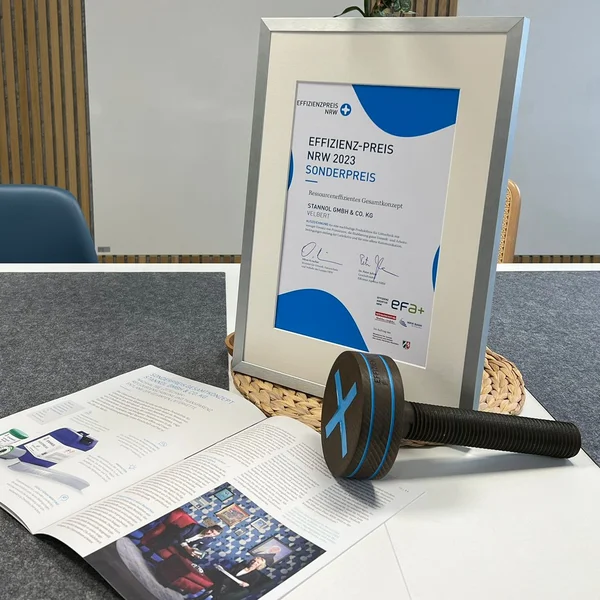
Stannol has been honoured with the Efficiency Award NRW 2023 for its greenconnect product line and its overall concept.
Our greenconnect product range
The film was made as part of the NRW Efficiency Award ceremony. The video is only available in German.
Fairtin by Stannol
Tin from defined sourcing channels
Fairtin is a Stannol brand for tin sourced in accordance with defined requirements relating to origin, traceability, suppliers and raw material quality. The solder wires, solder pastes and solder bars in our greenconnect range use primary tin from sources assessed against defined social and environmental criteria. Alternatively, solders made from high-purity secondary raw materials produced in Europe are used.
Both options meet the applicable requirements for quality, purity and processability. The specific criteria and available supporting documentation are provided on a product- or batch-specific basis.


The following criteria, among others, are taken into account for Fairtin products:
- environmental protection measures,
- compliance with applicable national and international requirements,
- measures addressing social responsibility towards employees and local communities, for example in relation to pay and occupational health and safety,
- measures to prevent child labour, and
- transparency regarding business activities and supply chains.
Fluxes – bioethanol instead of IPA
In our greenconnect bio-based fluxes, isopropyl alcohol (IPA) is replaced with bioethanol. The bioethanol used is derived from renewable feedstocks, such as food waste. Depending on the feedstocks and production process, bioethanol can generate lower greenhouse gas emissions than fossil-based IPA.
Water-Based Fluxes
In addition to our bio-based fluxes, Stannol offers water-based greenconnect fluxes. These non-flammable formulations contain no alcohol-based solvents, which can simplify storage and handling requirements. They can also reduce solvent-related emissions compared with equivalent alcohol-based fluxes.
No requalification necessary
The high quality standard of our own products ensures that some greenconnect materials can be used in the respective manufacturing process without costly requalification.
Our greenconnect products

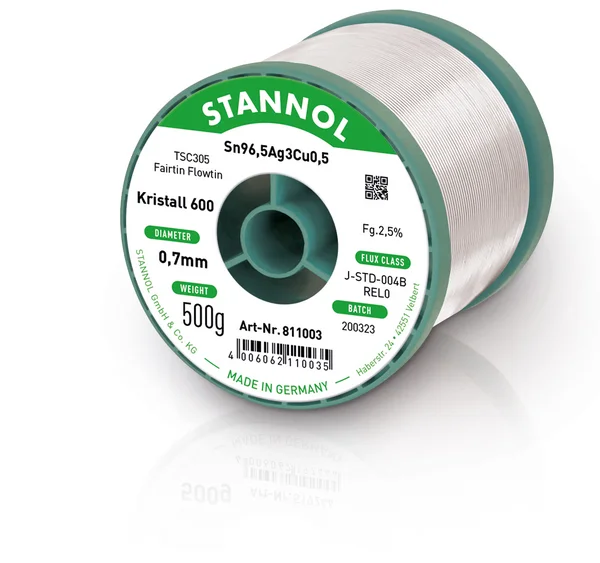
Solder Wire – Kristall 600
Although mildly activated, Kristall 600 solder wire ensures fast and good wetting on most surfaces. The contained flux is halide-free and based on a synthetic resin matrix. The high thermal stability makes the contained flux very suitable for use with all lead-free alloys.
Product Advantages
- Fairtin solder
- No-Clean
- transparent, clear residues
- strongly reduced spitting
- high thermal resistance
- good wetting
- REL0 classification
Application Areas
Kristall 600 solder wire can be used for both hand and automated soldering in the electrical engineering and electronics sectors. The flux residues are electrically safe and can remain on the solder joints. Kristall 600 is offered in the alloys Flowtin and SN100CTM. Both alloys are gentle on the soldering tips, which significantly increases their service life.
Solder Wires – Kristall 605 and 611
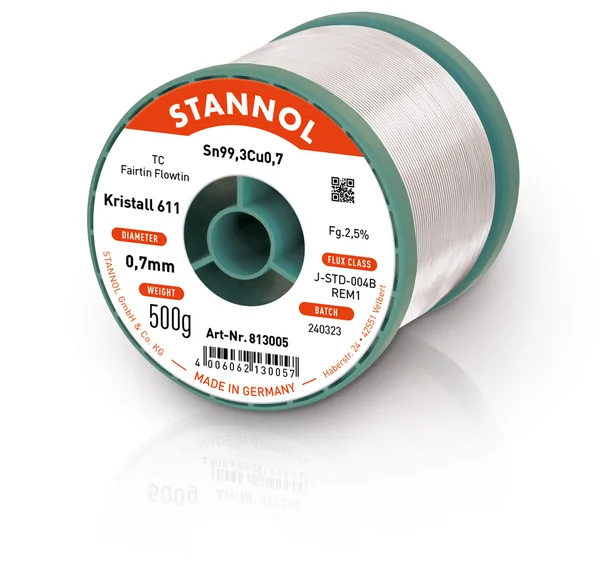
The Kristall 605 and Kristall 611 solder wires are halogen-activated flux solder wires that open the process window in many places. Greatly reduced flux spitting combined with good wetting behaviour on poorly solderable surfaces are the highlights of these innovative products.
Product Advantages
- Fairtin solder
- bright No-Clean residues
- low spitting
- very good wetting properties for fast soldering
- chemically modified resin that reduces the health risks associated with the use of rosin-based fluxes
- mild odour
Application Areas
Designed for manual rework as well as for automated soldering equipment, Kristall 605 and Kristall 611 allow to cover the different production needs in modern electronics manufacturing. The flux contained meets the requirements of J-STD-004C standards. Kristall 605 is classified as REL1, and Kristall 611 is classified as REM1. Both solder wires are offered in the alloys Flowtin and SN100CTM. These alloys are gentle on the soldering tips, which considerably increases their service life.
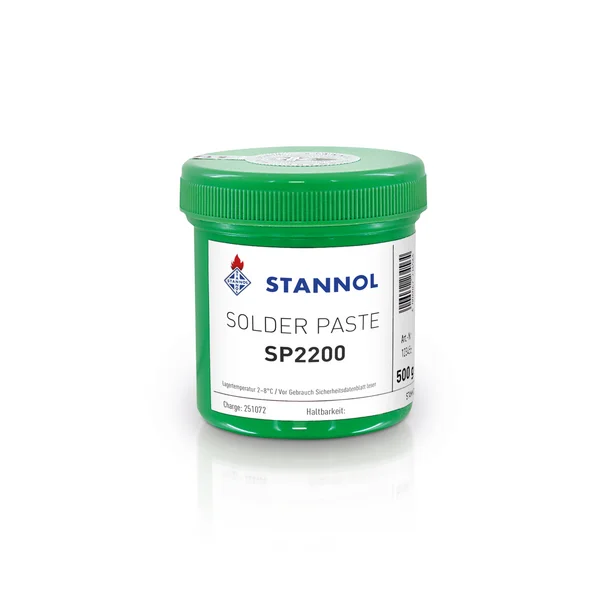
Solder Paste – SP2200
SP2200 solder paste is designed for high-volume, lead-free SMD electronics manufacturing. It contains a highly active L0 No-Clean flux. With a special formula for excellent wetting, it meets the requirements for surfaces found in any high-volume production today. The small amounts of residue left after the reflow process are bright, transparent, electrically safe and do not require removal.
Product Advantages
- solder powder made from Fairtin solder
- very good first print results after long printer downtime
- reflow process under air or nitrogen possible
- high open time of the printed PCB
Application Areas
The solder paste SP2200 was developed for stencil printing. With the TSC405, TSC305 and TSC0307 alloy as solder powder in classes 3 and 4, the solder paste SP2200 can be used in all common open and closed printing systems.
Solder Paste – SP6000
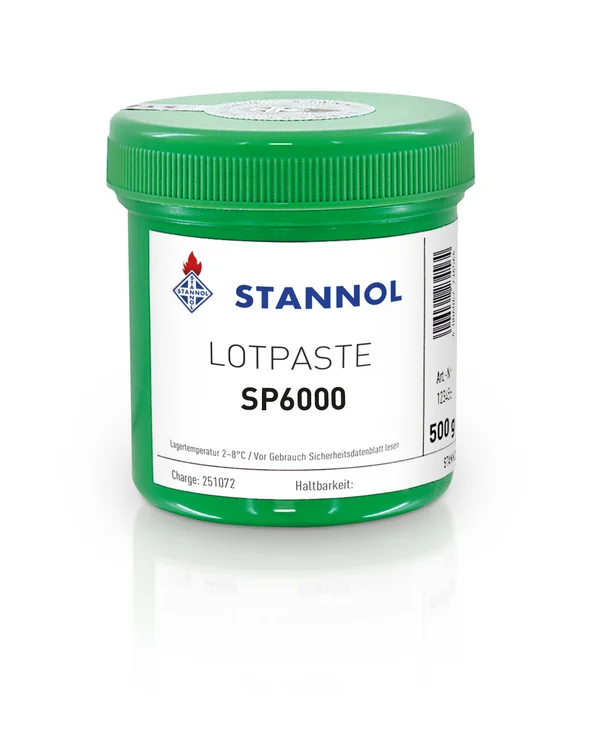
The SP6000 solder paste was developed for use with lead-free alloys. The use of recycled solder can reduce raw material-related CO2 emissions compared with equivalent solder pastes made from primary tin. The flux, which is classified as REL0, also convinces with an uncompromising wetting quality on all known lead-free PCBs in both air and nitrogen atmospheres. SP6000 leaves behind exceptionally little residues, which are also transparent and non-corrosive.
Product Advantages
- solder powder made from recycled solder
- very suitable for use with low silver content (TSC105)
- high contour stability, ideal for fine pitch up to 0.4 mm
- very good first print results after longer printer downtime
- reflow soldering process under air or nitrogen possible
- low mid-chip balling on passive components due to anti-capillary effect
- very good wetting on most surfaces
- RoHS compliant
Application Areas
The solder paste SP6000 was developed for stencil printing. With lead-free alloys as solder powder in particle size 4 (particle size 5 on request), solder paste SP6000 can be used in all common open and closed printing systems. It is also available as a dispensable solder paste (SP6000D).
More information about our SP6000-series:


Flux – EF350 Bio
The halogen-free activated No-Clean flux EF350 Bio guarantees excellent wettability on different surfaces (for example OSP, Ni/Au, HAL, chem. Sn and chem. Ag) with both lead-free and lead-containing solder alloys. Important for our customers: Extensive testing has proven that 1:1 flux replacement is possible without changing process parameters.
Product Advantages
- contains raw materials of bio-based origin
- No-Clean
- universally applicable
- solids content 3.5 percent
- very good wetting properties
Application Areas
EF350 Bio is a flux with a wide process window and can be used universally. It can be used in wave soldering as well as in selective soldering. EF350 Bio is well suited for use in spray fluxers.
Solar Fluxes – EF160 Bio PV and EF180 Bio PV

The fluxes EF160 Bio PV and EF180 Bio PV were specially developed for use in the photovoltaic module industry and, as No-Clean fluxes, meet all its requirements. Both fluxes are halogen- and resin-free and low in solids. EF180 Bio PV has a slightly higher solids content in comparison and has a lightly stronger activation than EF160 Bio PV. The innovative fluxes ensure very good solderability in module assembly processes for soldering by IR and convection.The use of bio-based raw materials reduces the proportion of fossil-based raw materials while maintaining the same technical quality requirements.
Product Advantages
- No-Clean
- low residue – minimal equipment contamination, low maintenance
- low solids content
- excellent peel force resistivity
- very good wettability
Application Areas
EF160 Bio PV and EF180 Bio PV offer a wide thermal process window, making them suitable for lead-free and leaded soldering processes. They exhibit high peel forces that keep solder joints stable over the long term. The fluxes can be applied by spray or dip processes. They are suitable for both automated spray and stringer applications and can also be used for hand soldering.
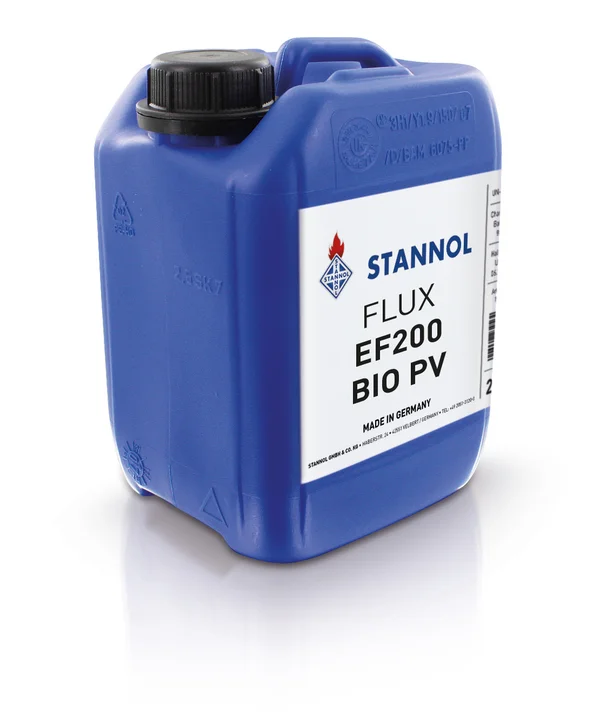
Solar Flux – EF200 Bio PV
EasyFlux EF200 Bio PV has been specially developed for use on solar cells and other sensitive surfaces. Due to the halogen-free activation, an excellent wetting ability is achieved. In addition, it leaves hardly any visible residues. This makes EF200 Bio PV the ideal choice for applications where absolute surface cleanliness is required. According to DIN-EN 16785-2, a 98 percent bio-based content is determined.
Product Advantages
- low residue and non-corrosive
- excellent peel force resistivity
- outstanding wettability on solar cells
- J-STD-004 (modified), class ORL0
Application areas
EF200 Bio PV is ideally suited for both automated spray and stringer applications. It can also be used for manual soldering. The flux fulfils the requirements regarding optical cleanliness and leaves only little residues in the soldering system.
Water-Based Fluxes – WF130 and WF131

WF130 and WF131 are developments of water-based ORL0 fluxes. Both deliver perfect soldering results and leave very low amounts of electrically harmless residues in combination with an extremely low corrosion potential. Both water-based fluxes are halogen-free and have a VOC content of less than one percent. Due to the very low corrosive potential, both can be classified as L0, which is not often possible with water-based fluxes. The main difference of the WF131 is a further reduction of the residue level, with the small trade-off of a slightly smaller process window.
Product Advantages
- No-Clean
- suitable for lead-free soldering with all common alloys
- application by spray fluxer
- non-flammable formulation (VOC content < 1 percent)
- good wettability and good through-hole filling
- water-based
Application Areas
WF130 and WF131 show good wetting on oxidised copper as well as on all common protective surfaces (HAL, Ni/Au, chem. Sn and chem. Ag). They also ensure excellent filling of through-holes.

Water-Based Flux – WF300S
WF300S is a halogen-free flux designed primarily for consumer electronics manufactured in regular or nitrogen atmospheres. WF300S has been specifically optimised to reduce solder balls between adjacent connections.
Product Advantages
- No-Clean
- extremely effective on poorly solderable surfaces, e.g. oxidized copper
- optimised for the reduction of solder balls
- non-flammable formulation (VOC content < 1 percent)
- water-based
Application Areas
WF300S was developed for use in spray fluxers. The flux has been formulated to work on oxidised copper as well as on all common protective surfaces such as HAL, OSP or Ni/Au.
Flux for selective soldering – SF1000 Bio
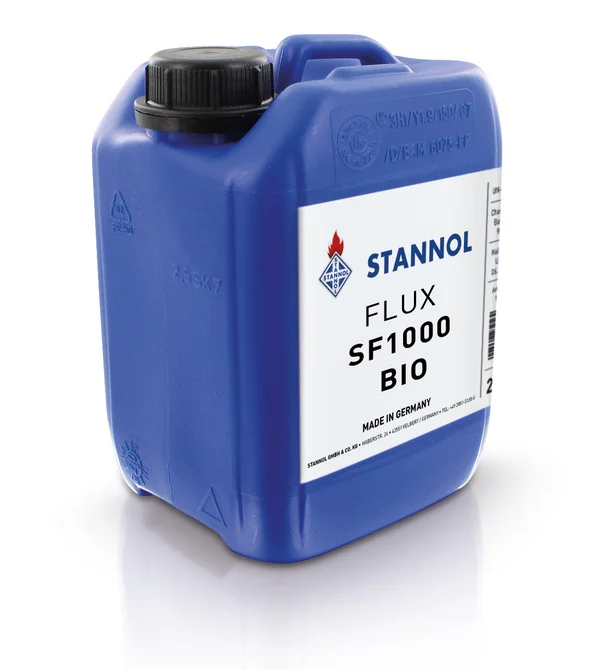
The flux SF1000 Bio was specially developed for selective soldering of electronic assemblies. The low solids content in combination with specially adjusted halogen-free activation results in excellent wettability of a wide variety of surfaces (e.g. OSP, Ni/Au, HAL), even with lead-free solder alloys. According to DIN-EN 16785-2, a 95 percent bio-based content is determined.
Product Advantages
- No-Clean
- low residue
- resin-free
- optimised solids content
- fast wetting
- wide process window
- good penetration
- J-STD-004C, class ORL0
Application Areas
Stannol SF1000 Bio can be used in spray fluxers. It shows good wetting at soldering temperatures in the range of 260 °C to 320 °C. It can also be used in other soldering processes such as wave and dip soldering.
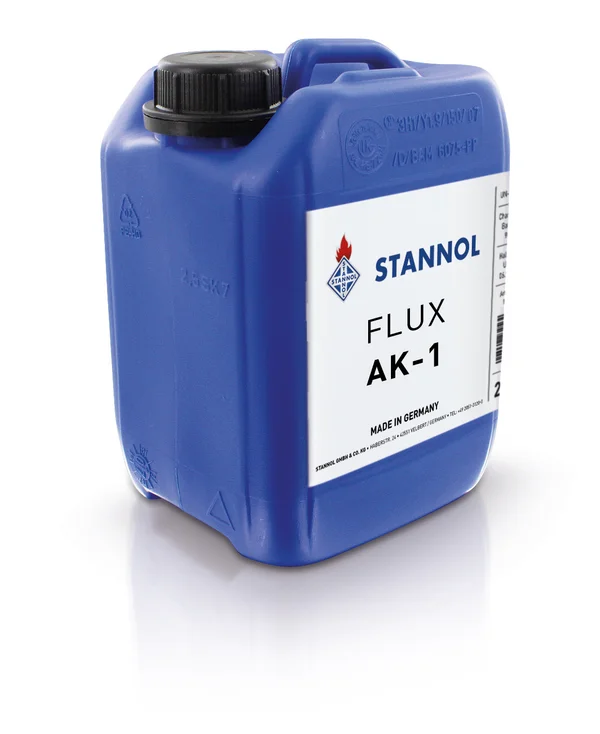
Special Flux – AK-1 Bio
The halogen-free No-clean flux AK-1 Bio was specially developed for cable tinning, tinning on component connections and soldering on copper or copper-passivated surfaces. According to DIN-EN 16785-2, a 90 percent bio-based content is determined.
Product Advantages
- No-Clean
- resin-free
- very well suited for dipping processes
- J-STD-004 modified, class ORL0
Application Areas
AK-1 Bio is preferably applied by dipping. The application method depends on the specific use; brush and dispenser application are also suitable. Dip and wave soldering, induction soldering as well as soldering with hot plate or soldering iron is also possible.
Contact person
Do you have any questions about our products?
Our application engineers will be happy to help you. Contact us, we are here for you!
All Landline numbers are extension numbers and must be preceded by +49 2051 3120- for Germany.
Distribution Network
Further countries with our distributors' contacts can be found here:
Distribution Network