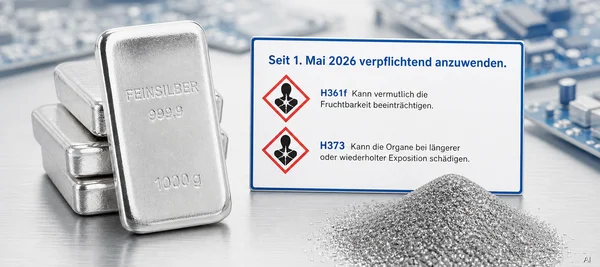
New CLP Classification for Silver
Was dies für SAC305, Lotpasten und Barrenlote bedeutet
Effective May 1, 2026, the harmonized classification of elemental silver set forth in Delegated Regulation (EU) 2024/2564 applies. Silver is a component of many established solder alloys – therefore, this change affects safety data sheets, labeling, and risk assessments in electronics manufacturing.
This does not entail a ban. We have compiled an overview of the specific changes, which product forms are affected and how – and how we can support you.
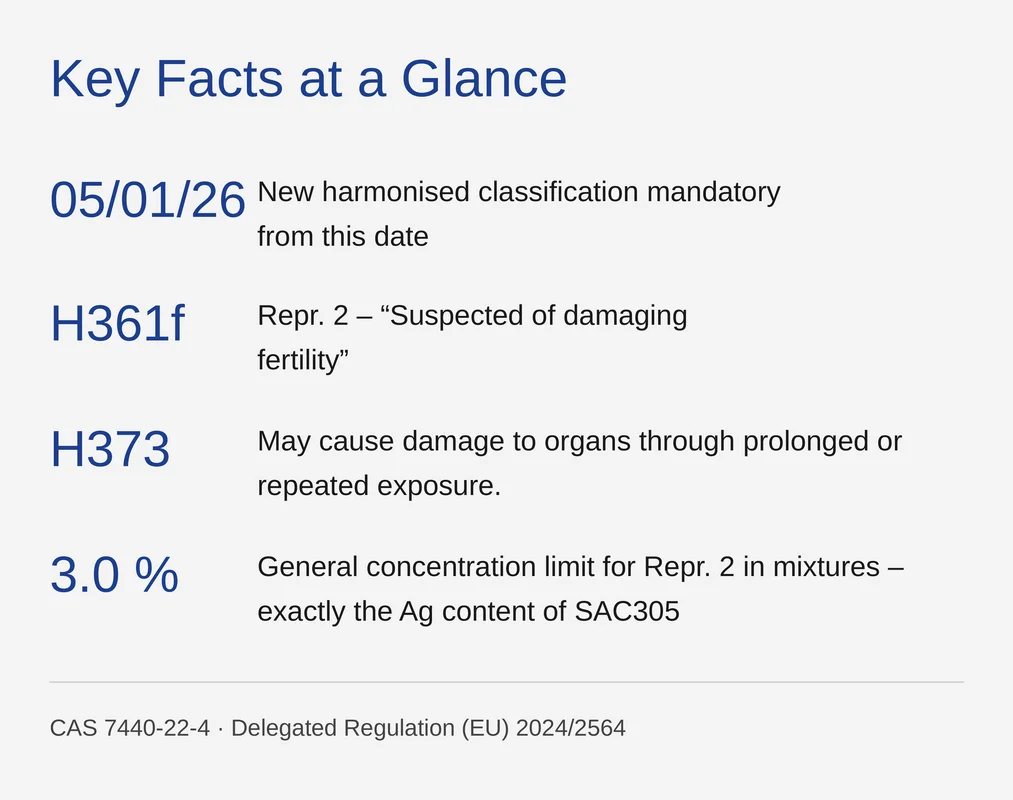
Timeline
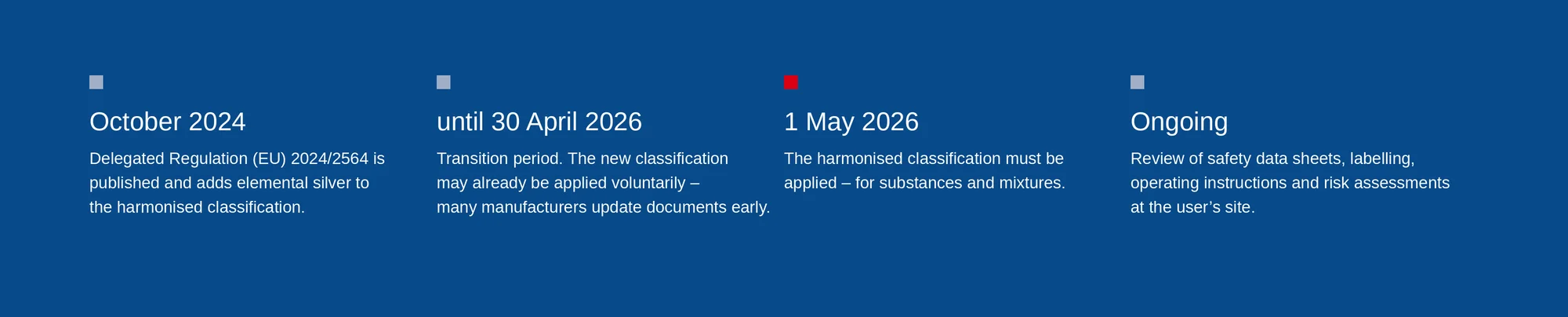
What Has Changed With Silver
This applies to elemental silver (CAS 7440-22-4). The regulation explicitly distinguishes based on particle size – the physical form is a determining factor in which classification applies.
Form 1
Solid silver
Particle diameter starting at 1 mm. Typically used for ingots, bars, wire, and solid metal forms.
Repr. 2 · H361fSTOT RE 2 · H373
Form 2
Silver powder
Over 100 nm to less than 1 mm. The form relevant to solder pastes – the metal is present as a fine solder powder.
Repr. 2 · H361fSTOT RE 2 · H373 + Hazardous to aquatic environments
Form 3
Silver nanoparticles
Over 1 nm to 100 nm. Uncommon in conventional solder products, but relevant for sintering pastes and specialty applications.
Repr. 2 · H361fSTOT RE 2 · H373 + Hazardous to aquatic life
Why SAC305 is located exactly on the border
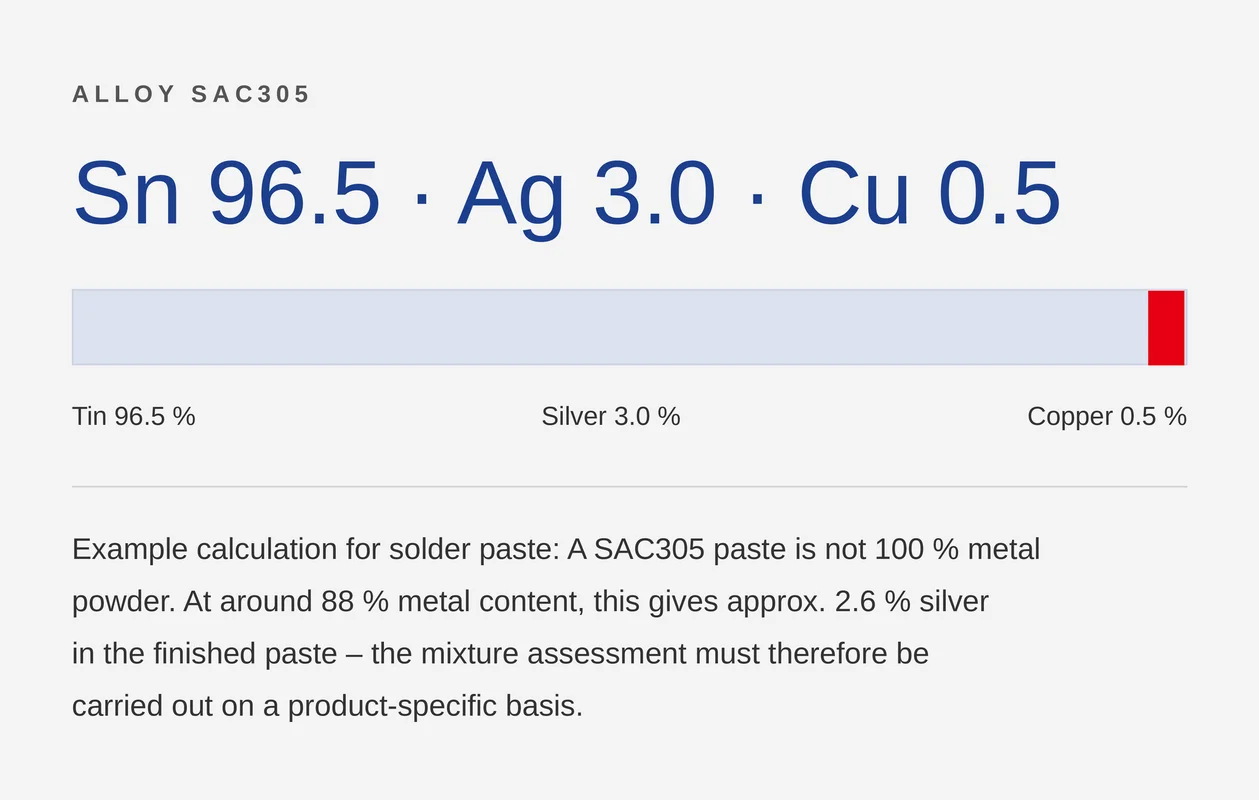
According to the general CLP rules, a component classified as Repr. 2 results in the mixture being classified as toxic to reproduction, Category 2, at concentrations of 3.0 percent or higher – provided that no specific concentration limits to the contrary apply. SAC305 contains exactly 3.0 percent by weight of silver. The standard composition thus falls precisely on a regulatory threshold – and the assessment depends on the specifics of the particular product form.
Product Form and Classification at a Glance
It is not the product name that matters, but rather the physical form of the silver it contains, which is relevant for CLP classification. This overview shows what to look for in common soldering products.
| Product Form | Form of the Silver | Relevant Classification | What to Check |
|---|---|---|---|
| Rods & Ingots | Solid, ≥ 1 mm | Repr. 2 H361f · STOT RE 2 H373 | Update the safety data sheet and labeling |
| Solder wire | solid | Repr. 2 H361f · STOT RE 2 H373 | Additionally, include the flux core in the mixture assessment |
| Pellets & Preforms | solid – dimensions are decisive | case-by-case basis | Document geometry; do not treat them uniformly like ingots |
| Solder paste | Solder powder > 100 nm to < 1 mm in the flux medium | Mixture assessment, plus aquatic hazard if applicable | Actual Ag content of the paste, not just the alloy |
| Sintering & silver pastes | Powder or nanoparticles | Repr. 2 · STOT RE 2 · aquatic classifications | Verify particle size reliably |
Guidance. The official classification of a specific product is determined by its current safety data sheet.
Does that mean SAC305 can no longer be used?
No.
A CLP classification is, first and foremost, a hazard classification, not a ban. Therefore, established SAC305 processes do not need to be changed. However, it is necessary for the regulatory assessment of the products used to be up to date – for manufacturers, importers, and downstream users alike.
What You Should Check Now
Six steps to help you work through the transition in a structured manner – for QM, EHS, Manufacturing, and Purchasing together.
1. Safety Data Sheet
Are there current MSDSs available for all pastes, ingots, wires, pellets, and preforms used that take into account the new silver classification?
2. Silver Content
Record the actual Ag content for each item. SAC305 has a content of 3.0%; other alloys have contents significantly lower or higher than this.
3. Product Form
Do not automatically treat paste, ingots, and wire the same – the physical form of the silver is relevant for classification.
4. Labeling
Changes in classification affect the hazard pictogram, signal word, and H-phrases – as well as internal repackaging and storage labeling.
5. Assessment
Adapt and document operating instructions, substitution testing, and training to reflect the revised hazard classification.
6. Alloying Strategy
A good opportunity to review the portfolio – but regulatory aspects should never be considered in isolation from process and reliability.
Are low-silver alloys automatically the better choice now?
Not necessarily. The silver content affects not only costs and regulatory assessment but also the technical behaviour of the alloy. A change must therefore always be evaluated on a process-specific basis.
The question is not “How do we avoid silver?” but rather: Which alloy offers the best balance of process reliability, dependability, cost, and regulatory compliance for this application?
No-clean solder pastes with reduced silver content, such as SP6000 and SP6500, may be an option – but switching is only advisable after an evaluation of your reflow process. That’s exactly what our testing and analysis service is for.
To be evaluated before changing alloys:
- Melting range and reflow profile
- Wetting behaviour
- Mechanical properties
- Thermal reliability
- Voiding
- Component and Surface Compatibility
- Existing customer approvals and qualifications
Downloads
Aktuelle Dokumente zu Ihren Produkten
Safety Data Sheets, Technical Data Sheets, and REACH/RoHS information are available in the download section—each in its currently valid version.
Talk to us
Would you like to know which of your products are affected, do you need updated documentation, or are you considering reviewing your alloy strategy? Our application engineering team is here to support you—from documentation to evaluation during the reflow process.
Consultation on
Documentation Status
We’ll work with you to identify which items require new safety data sheets and labeling.
Testing & Analysis Services
Evaluation of an alloy change in the in-house laboratory, including documentation.
Newsletter
Information on the latest developments – stay up to date.
Our expert will be happy to assist you

Note
This page provides general technical information as of September 2026 and does not constitute legal or regulatory advice. Only the text of Regulation (EC) No. 1272/2008 (CLP), as amended, Delegated Regulation (EU) 2024/2564, and the current safety data sheet for the specific product are binding. No liability is assumed for the completeness or timeliness of the information summarized here. The assessment of classification, labeling, and hazard evaluation within the user’s own operations is the responsibility of the respective user.